

( English pages are under construction )
Current Exhibitions
Curatorial Graffiti--more
SEMIGAKU(study of cicadas) -- World of Masayo Katoh--more
FORMS and FORCES -- morpho-diversities --more
MOBILEMUSEUM 001 (at Akasaka Intercity) ---more
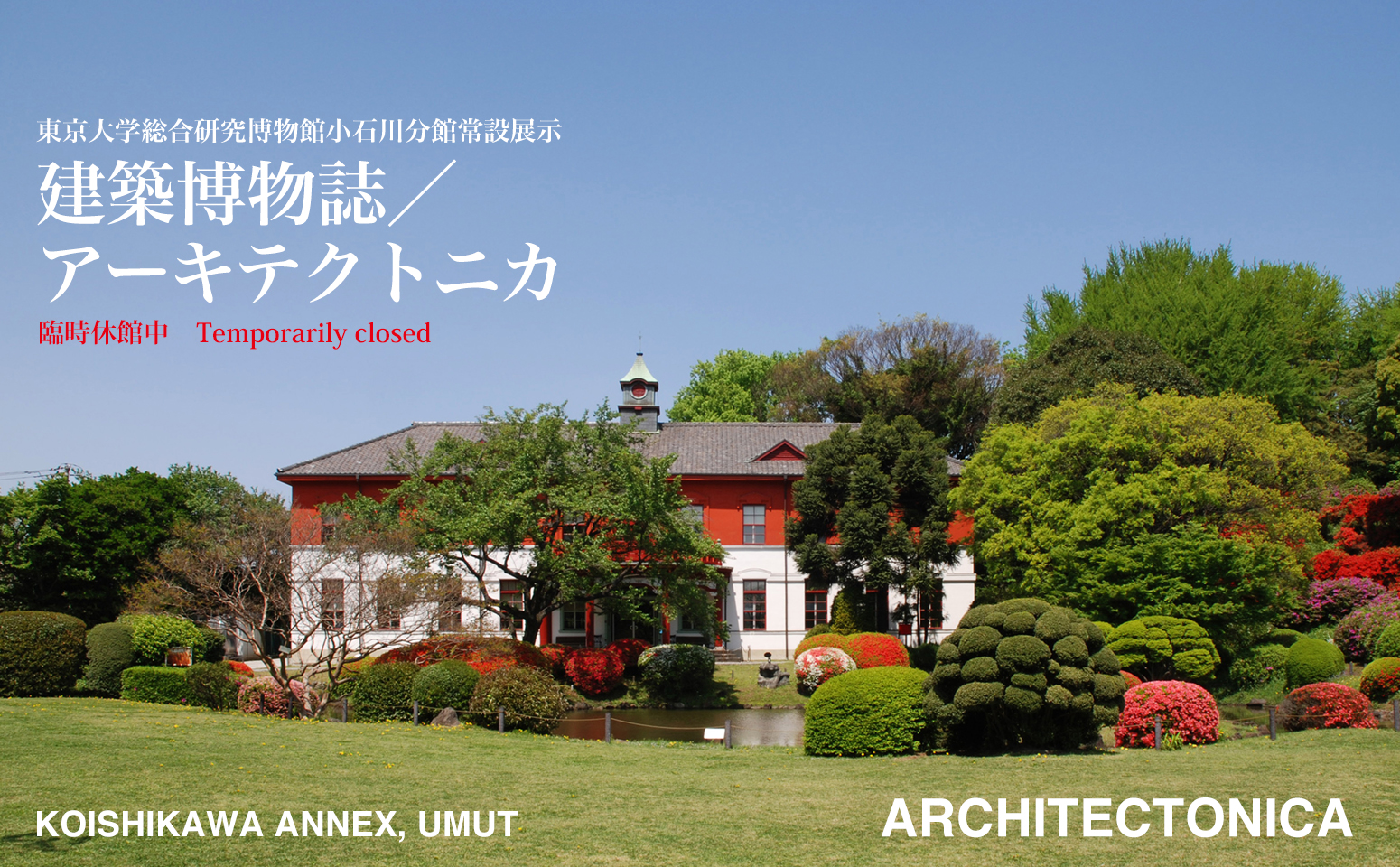
The Chambers of Curiosities (at Koishikawa Annex) ---more
Togakushi Museum of Geology and Fossils --more
Makabe Historical Museum --more
The Present and Future of the University Museum
The history of The University Museum goes back to 1966, when the University Storage Center for Research Materials was founded. This institution served various faculties since 1966. The main objective of the University Storage Center was collecting, classifying and preserving natural, cultural and historical research materials, in order to make these accessible for research. Apart from research, the collections were used for education, publication, and exhibition. In order to correspond to increasing demands, the University Storage Center became the first University Museum in Japan in 1997.
The objectives of the museum can be summarized as follows:
Collecting, classifying and preserving a large variety of natural and cultural objects;
Making this material accessible for research and education;
Publication of the materials, including databases;
Organizing exhibitions of the collections
Promoting of research related to the collections.
The University Museum the University of Tokyo is one of the leading university museums in Japan and as before, it tries to make a contribution to science and society in the 21st century. By means of making accessible its various collections, The University Museum shall continue to stimulate academic research. And of course, being a public institution, we strive to make this research available to the "wider public", so that society as a whole can benefit.
At present, the museum staff consists of 7 persons: 4 professors, 1 associate professor, and 3 assistant professors. This staff is related to 3 departments: the Department of Curatorial Studies; the Department of Museum Collection Utilization Studies; the Department of Museum Informatics and Media Studies. Complementing the staff are 2 research assistants (working in respectively the Koishikawa Annex and the Laboratory for Radiocarbon Dating), 2 visiting professors, and 1 visiting associate professor (Museum Technology).
The above are evidently insufficient enough to cover the large range of scientific fields relating to the research materials stored in the museum. For this reason we invite faculty members of other institutions of the university as "interfaculty staff" to make the best use of their expert knowledge. Those "interfaculty staff"s belong to the Departments of Material, allocated into 17 specific units.
The intensive research in the museum has, among other things, thus far resulted in a large number of scientific papers, among which are; 60 volumes of Research Materials Reports; 40 volumes of Research Bulletins; 6 volumes of Collected Research Reports; 5 volumes of Research Reports; 2 volumes of UMUT Monographs.
The University Museum is one of the so-called interfaculty facilities. Apart from research, the staff is engaged in graduate education, presentation of lectures, and providing all kind of information. We especially welcome graduate students to make use of the museum's many facilities. At the moment, the University Museum is examining the possibility of establishing a graduate school, aimed at producing high quality researchers in various disciplines. As indicated above, we believe that university museums should and can play important roles for both the scientific community and the wider public. This is mainly to be achieved by means of research, education and exhibition. We encourage everybody to make use of our facilities.
The University of Tokyo owns 6,400,000 research objects; 2,430,000 of these are located in The University Museum. And the collection is growing steadily by means of active research (e.g. overseas fieldwork), or obtaining collections from both public and private sources. Due to the huge numbers of objects, we currently face a chronic shortage of space. Already in 2000, this problem was acknowledged by the "External Evaluating Committee" (who, by the way, rated the activities by the University Museum high). At present, the museum covers an area of 8,759 m². The exhibition space is large enough, but research and especially storage space need to be enlarged. In fact, due to limitations of space, the museum is currently not able to function properly with regard to one of its basic tasks: storing and preserving (scientifically) valuable materials. As a worst-case scenario, it is even possible that collections have to be reduced, or housed elsewhere.
The Departments of Research and Material
Two of the most basic units within the museum are the departments of research and material.
The Department of Research
This department includes three closely cooperating basic units. Each of them aims to cover activities for "basic stratum", "fusion", and "circulation" of research. The rest comprise another group of three facilities, which complements the basic units in more specialized respectives.
Department of Curatorial Studies
This department is the "basic stratum" of the University Museum; it is in charge of collecting, classifying, and preserving research materials.
Department of Museum Collection Utilization Studies
It promotes "fusion" in the University Museum, planning to use accumulated research materials effectively and repeatedly.
Department of Museum Informatics and Media Studies
This department "translates" the results of academic research for the wider public (public relations), hence enabling "circulation" of scientific information generated in the museum
Department of Museum Technology
This additional department was established in 2002, conceived as a cooperative "think tank" with regard to the intricacies of exhibition.
Laboratory for Radiocarbon Dating
In this facility we are able to measures the accurate date of various organic materials from geological, archaeological or historic contexts.
Koishikawa Annex
In the Koishikawa Annex, attractively located near the universities' Botanical Gardens, temporary exhibitions are held, and objects and databases are stored and made available to researchers and the public.
The Department of Material
This department consists of three units, sub-divided into seventeen sections, owning over 2,430,000 items mainly from natural and cultural history:
Departments of Earth Science:
Mineralogy, Petrology and Mineral Deposits, Mining, Historical Geology and Palaeontology, Geography Departments of Biology:
Botany, Forest Botany, Pharmaceutical Science, Zoology, Fishery, Physical Anthropology and Prehistory, Medicine
Departments of Cultural History:
Archaeology; History of Architecture; Archaeology of Fine Arts; History of Fine Arts; and Cultural Anthropology
Museum Staff
Director
Yoshiaki Nishino, D.Litt., Professor, History of Fine Arts, Museum Technology
Department of Curatorial Studies
Gen Suwa, Ph.D., Professor, Physical Anthropology
Takenori Sasaki, Ph.D., Assistant Professor, Zoology
Department of Museum Collection Utilization Studies
Yoshihiro Nishiaki, Ph.D., Professor, Archaeology
Hideaki Miyamoto, Ph D, Associate Professor,
Earth and Planetary Science
Department of Museum Informatics and Media Studies
Yoshiaki Nishino, D.Litt., Professor, History of Fine Arts, Museum Technology
Tomonori Usaka, Ph.D., Assistant Professor, Information Science
Tadashi Fujio, Assistant Professor, History of Japanese Architecture
Department of Museum Technology
Tsuneo Koh, Affiliate Professor, Space Design
Fumio Matsumoto. Affiliate Associate Professor, Architectiural and Information Design
Ai Tanikawa, Research Fellow, Museum Resources Studies
Hiroyuki Sekioka, Research Fellow, Museum Design
Laboratory for Radiocarbon Dating
Kunio Yoshida, D.Sc., Assistant Professor, Archeometry
Administration
Head: Kouzou Miura
Other: Megumi Mikamoto, Masayuki Tomita, Hiroe Tazaki, Masashi Tsuchiya, Kazuteru Saegusa, Keiko Murayama, Sai Kataoka, Kimie Tohyama
