


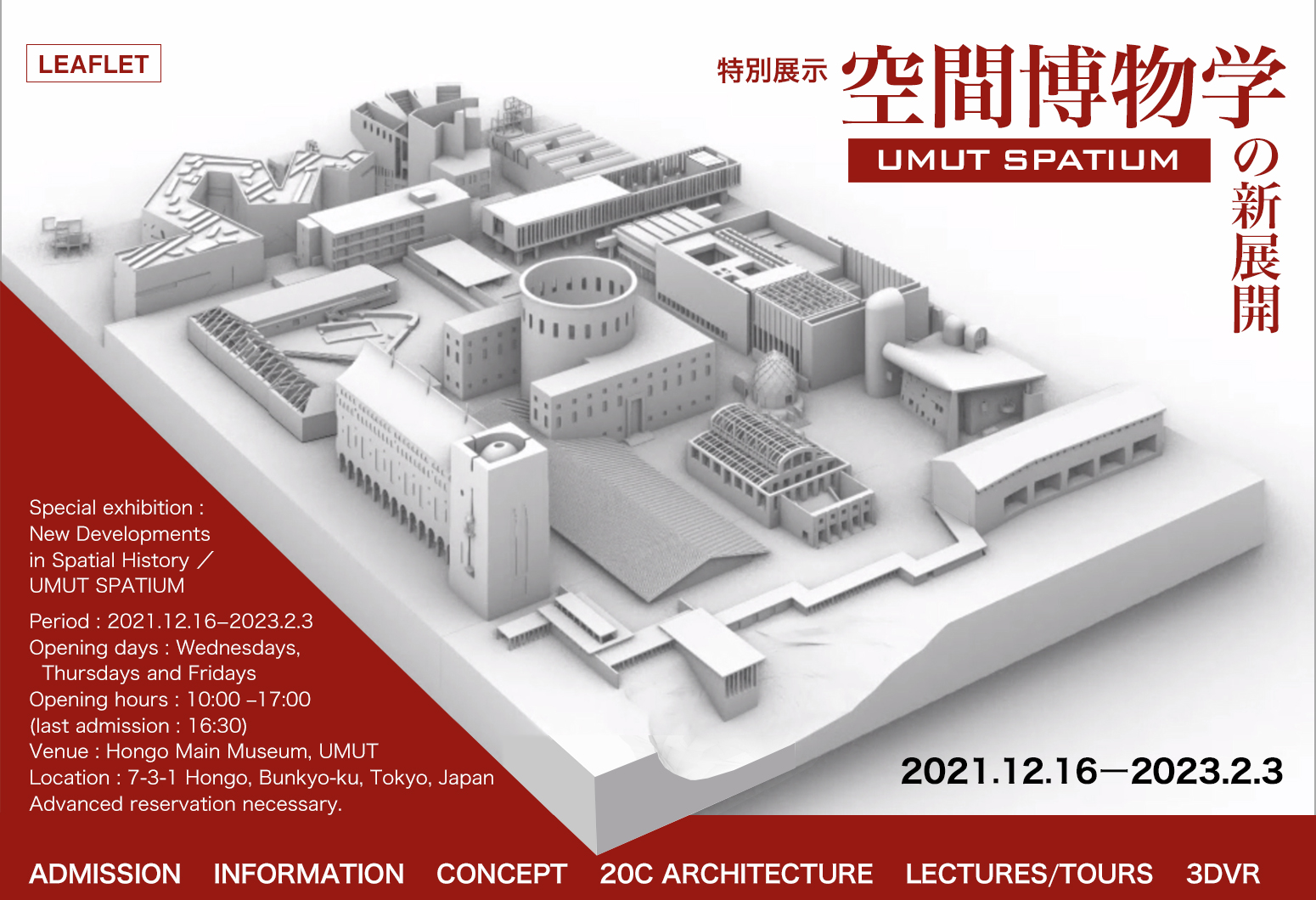
Special Exhibition, UMUT
New Developments in Spatial History / UMUT SPATIUM
From Space Collections to Space Creations
"Space” is the form in which the world is built and the basis of our existence. However, what is meant by the word "space" is not uniform. Various concepts of space have existed over the ages. Broadly speaking, space can be thought of as a place, expanse, and relationship. “Space as a place" is a local space derived from Aristotle's topos. "Space as an expanse” is an infinite homogeneous space defined by the Cartesian coordinate system. "Space as a relation” is a networked space in which physical unity is not essential. The expansion of the spatial concepts of place, expanse, and relation is deeply related to the diversity of human-space relations in contemporary society.
In the field of architecture, the idea of universal space was born in the 20th century. Architectural planning has been based on the "building type" such as an office and a school. The recent coronavirus pandemic spurred a change in the nature of proximity between humans. New possibilities can be found in the organic coordination of smaller space types that do not necessarily presuppose a pre-existing building type.
On the other hand, the field of natural history does not collect space as a specimen. In academic research, specimens are treated as objects, not spaces. Many specimens are separated from space and preserved as objects themselves. In natural history, nature was classified into the animal, plant, and mineral kingdoms. The spaces in which they belonged were discarded. One of the new challenges awaiting natural history would be to capture the amorphous object of space, collect the various spaces that humans experience, and utilize them for future research and design.
The special exhibition "New Developments in Spatial History / UMUT SPATIUM" aims to collect and preserve architectural and urban spaces, and to link them to the creation of new spaces in the future. The University Museum, the university of Tokyo has formed an architectural collection mainly in the Koishikawa Annex. The Koishikawa Annex (formerly the main building of the former Tokyo Medical School) has been closed since January 2021 after a seismic basic diagnosis in 2020 revealed that its seismic performance may be inadequate. This exhibition utilizes the resources of “ARCHITECTONICA,” a permanent exhibition at the Koishikawa Annex. We intend to assemble a new flow of contents through the creation of new architectural models and video works, and to present the direction of spatial history.
Exhibition Leaflet (PDF, Japanese)

Space specimens
Back to top